
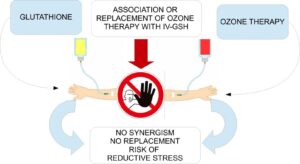
Comparison of IV-GSH and OOT
Intravenous administration of glutathione (IV-GSH) causes unnatural spikes in glutathione levels in the blood plasma. This can lead to reductive stress., a condition in which the body is flooded with reductive substances. Instead of providing protection, this can actually have harmful effects on the mitochondria and the immune system.
Ozone therapy (OOT) works in a completely different way. Instead of directly administering antioxidants, OOT stimulates the body to produce glutathione itself. This is done by activating natural signalling pathways such as the Nrf2/Keap1/ARE system, which triggers cell repair and protection. In addition, OOT also promotes the repair of the vascular wall (endothelium) and increases the availability of nitric oxide (NO), which is beneficial for blood flow and cell communication.
A mechanistic model shows that the GSH/GSSG system contributes only a small proportion to the total therapeutic effect of OOT, less than 10% in adults and approximately 2% in the elderly. The main contribution comes from adaptive biological pathways that help the body regulate itself.
The model calculations further show that ozone therapy leads to rapid and almost complete improvement within six months, while IV-GSH reaches a plateau early on with limited further progress.
The researchers conclude that redox-targeted therapies should not only aim for maximum antioxidation. Both too much oxidative and too much reductive activity can be harmful. The key lies in restoring balance and stimulating the body's natural adaptive capacity.
The article concludes that IV glutathione not can simply be compared to or used as an equivalent of ozone therapy. OOT functions as a systemic bioregulatory treatment that activates multiple biological pathways, whereas IV-GSH only provides a direct antioxidant boost without an adaptive response. For clinical and therapeutic applications, this means that practitioners must be critical when it comes to antioxidant interventions: not only are the dose and safety relevant, but above all whether treatment stimulates the body to repair itself rather than merely suppressing oxidative stress.
If you are interested, please read the article:
Salvatore Chirumbolo, Marianno Franzini, Giovanni Ricevuti, Luigi Valdenassi,
Intravenous glutathione should not be mismatched with ozone as an antioxidant therapy, Biomedicine & Pharmacotherapy, Volume 188, 2025, 118197, ISSN 0753-3322, https://doi.org/10.1016/j.biopha.2025.118197.