
The role of light as a therapeutic tool has once again become a topic of great interest in recent years. An important turning point in this regard was the peer-reviewed article “Photobiomodulation for the ageing brain” (2021), published in the scientific domain via PubMed (PMID: 34325071). This review examines how red and near-infrared light, collectively referred to as photobiomodulation (PBM), can influence neurobiological processes that are crucial for healthy ageing.
The authors describe how PBM, through specific wavelengths, is able to improve cellular energy production, reduce oxidative stress and modulate inflammatory processes. In particular, the influence on mitochondria, the powerhouses of the cell, is a common thread running through the literature analysed by the researchers. With ageing, the efficiency of mitochondria declines, which has a domino effect on cognitive functions.
The review shows that PBM appears to offer protection against this decline in animal models and early clinical studies. Improvements were reported in memory, attention, mood, neuroplasticity and cerebral blood flow. Although the authors clearly state that larger-scale human studies are still needed, there is sufficient consistency in the published data to consider PBM a serious intervention for brain health in ageing.
The findings in this article closely align with the therapies we use in our practice. Sublingual laser therapy uses low-level laser light under the tongue, an area with a rich capillary network. This allows light to be absorbed quickly, after which it can exert its influence at a systemic level.
The LED helmet uses red and near-infrared light that is directed directly at the skull, with the aim of stimulating brain tissue via non-invasive light penetration. This is in line with the studies included in the review, in which transcranial photobiomodulation showed positive effects on cognitive functions and neurovascular dynamics.
Both methods are modern applications of the same biological principles highlighted in the article. They are part of growing international research into how light can activate recovery processes in the body without pharmacological intervention.
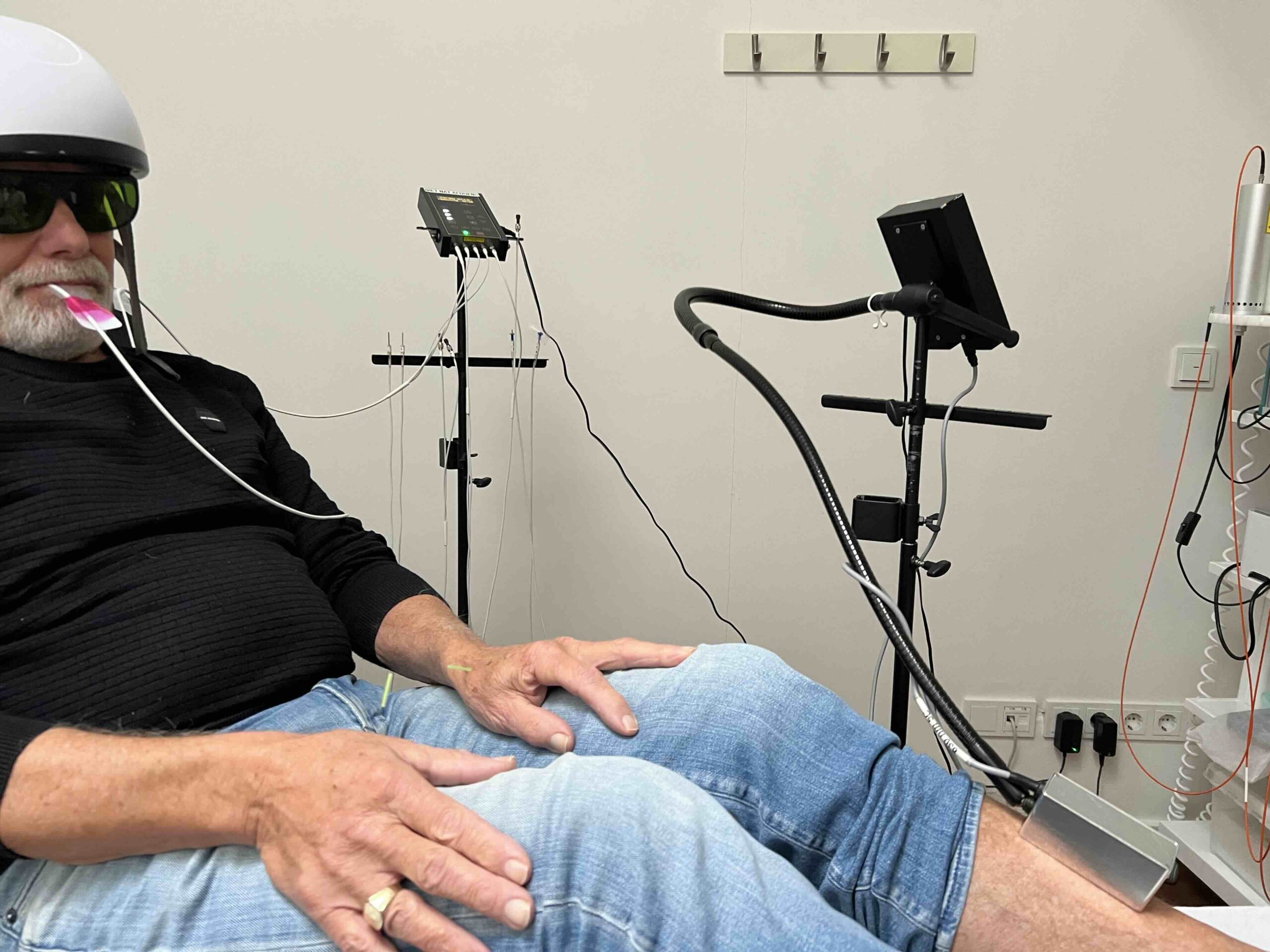
Here you see a satisfied patient. He is using LED help, sublingual low-level laser therapy and photobiomodulation of the bone marrow. According to the patient, the complementary therapy is accompanied by improved clarity of thought, an increased sense of control over situations, better concentration and a more stable mood.
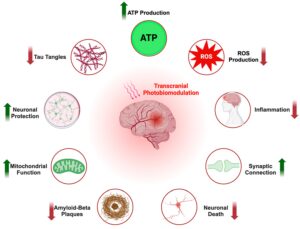
This schedule from the article: ‘Photobiomodulation as a Potential Treatment for Alzheimer’s Disease: A Review Paper’ shows the effects of PBM on important pathological features of Alzheimer's disease (AD). PBM increases ATP production, which can improve the energy balance of neurons. PBM has also been shown to reduce the formation of tau tangles, amyloid-beta plaques, reactive oxygen species (ROS) and inflammation, all of which contribute to neurodegeneration. In addition, PBM improves mitochondrial function, which helps to limit neuronal cell death. Red arrows pointing downwards indicate a decrease and green arrows pointing upwards indicate an increase. This process also takes place during treatment with the LED laser, LED helmet. The figure was created using BioRender.com (accessed on 25 October 2024).
Interesting sources that clarify the process of photobiomodulation of bone marrow include “Adjunctive laser-stimulated stem-cell therapy to primary reperfusion in acute myocardial infarction in humans: Safety and feasibility study. J Interv Cardiol”. – “Effects of Photobiomodulation on Stem Cells Important for Regenerative Medicine.
Sources consulted
Cardoso FDS, Gonzalez-Lima F, Gomes da Silva S. Photobiomodulation for the ageing brain. Ageing Res Rev. 2021 Sep;70:101415. doi: 10.1016/j.arr.2021.101415. Epub 2021 Jul 26. PMID: 34325071.
Elbaz-Greener G, Sud M, Tzuman O, Leitman M, Vered Z, Ben-Dov N, Oron U, Blatt A. Adjunctive laser-stimulated stem-cells therapy to primary reperfusion in acute myocardial infarction in humans: Safety and feasibility study. J Interv Cardiol. 2018 Dec;31(6):711-716. doi: 10.1111/joic.12539. Epub 12 July 2018. PMID: 29999208.
Wang, M., Dinarvand, D., Chan, C. T. Y., Bragin, A., & Li, L. (2024). Photobiomodulation as a Potential Treatment for Alzheimer’s Disease: A Review Paper. Brain Sciences, 14(11), 1064. https://doi.org/10.3390/brainsci14111064
Disclaimer: The photographs shown have been taken with the consent of our clients and are intended to illustrate the possible results of treatment. Results may vary significantly from person to person and depend on personal circumstances and factors. The examples shown do not guarantee the outcome of your own treatment.